How the projection works
Every paid social plan is the same four-step chain. Budget buys impressions at a CPM. Impressions become clicks at your CTR. Clicks become orders at your conversion rate. Orders times AOV is revenue.
Clicks = Impressions × CTR
Orders = Clicks × Conversion rate
ROAS = (Orders × AOV) ÷ Budget
The value of running the chain before launch is not precision. It is exposing which assumption your plan quietly depends on. If the projection only works at a 2.5% CTR, you don't have a media plan, you have a creative brief.
Worked example
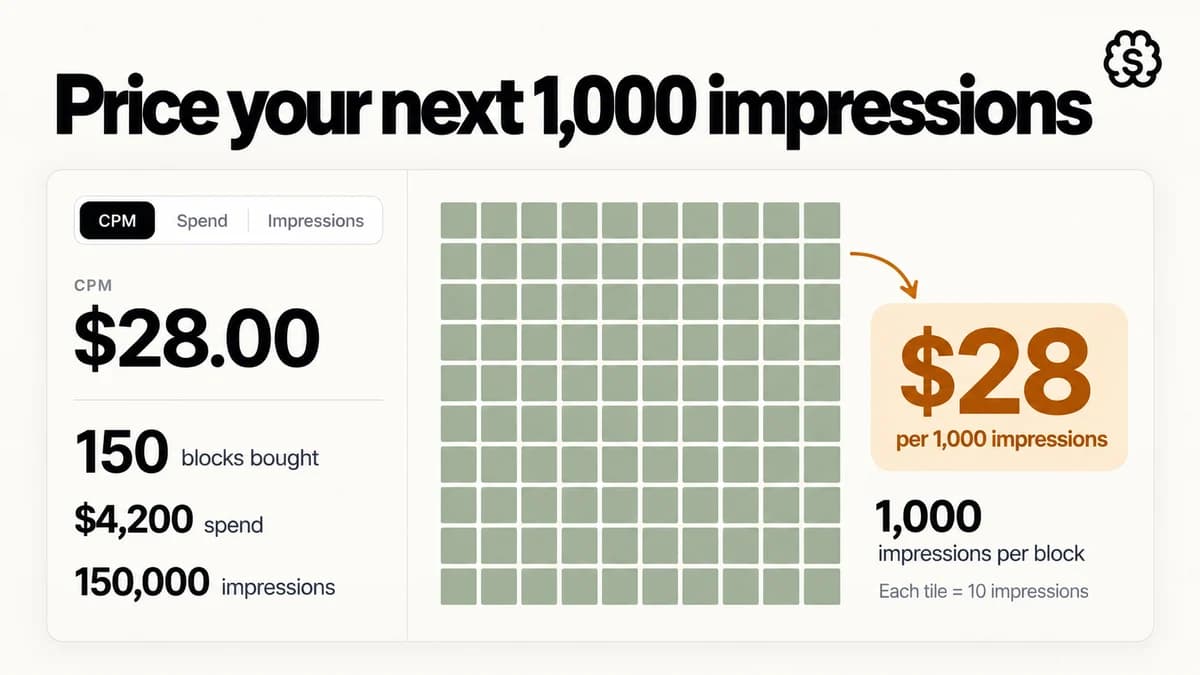
The defaults model a $10,000 month on Meta: $28 CPM, 1.5% link CTR, 3% conversion rate, $80 AOV. That buys roughly 357,000 impressions and 5,357 clicks at a $1.87 effective CPC. At a 3% conversion rate those clicks produce about 161 orders at a $62 CPA, and $12,857 in revenue, a 1.29 ROAS.
Whether 1.29 is good news depends entirely on your unit economics: with the break-even ROAS from an $80 order at typical DTC margins sitting around 1.76, this plan loses money despite respectable inputs. Nudge CTR to 2% and conversion to 3.5%, and the same budget returns a 2.0 ROAS. That swing is creative and landing page work, not budget work.
What numbers should you assume?
Use your own account history if you have it: last 30 days, per campaign type. Starting from zero, these are reasonable 2026 planning ranges for DTC on Meta, treated as directional, not gospel: CPM $20–45 (higher in Q4 and for narrow audiences), link CTR 0.9–1.8% (strong creative clears 2%), and click-to-order conversion 2–4% for a healthy product page at typical AOVs.
If a projection only pencils at the optimistic end of all three ranges at once, it will not survive contact with the auction. Plan at your medians and let upside be upside.
Which lever actually moves ROAS
CPM is set mostly by the auction and your audience; you rent it. CTR and conversion rate are yours. Because the chain multiplies, a 30% CTR lift and a 30% CVR lift compound to roughly 69% more orders from the same budget. That is why creative testing and landing page work beat budget shuffling in almost every account review. Chasing cheaper CPMs with broader delivery usually trades straight back into weaker CTR.
Frequently asked questions
How accurate is an ad spend projection?
Treat it as a ±30% envelope, not a forecast. Auctions fluctuate, creative fatigues, and conversion rates move with traffic mix. The projection's job is to kill plans that can't work at plausible inputs and to size the ones that can.
Should I use link CTR or CTR (all)?
Link CTR. CTR (all) counts reactions, expands, and profile taps that never reach your site, and will overstate the chain by 2–3×. The calculator's math assumes clicks that land on a page that can convert.
Why is my real CPA higher than the projection?
The usual suspects: CTR (all) instead of link CTR, a conversion rate measured on retargeting traffic applied to prospecting, or attribution counting orders your ads didn't drive. Re-run the numbers with cold-traffic conversion rates and the gap usually closes.
How many orders do I need before the numbers mean anything?
Rough rule: judge nothing on fewer than ~50 orders per cell, and prefer 100. Below that, a single lucky day moves CPA by double digits. Size test budgets so each variant can reach that threshold inside your patience window.
What budget should I start testing with?
Work backwards from significance: at the CPA this calculator projects, 50 orders defines a minimum test budget (about $3,100 at the example's $62 CPA). If that is too rich, raise AOV or improve the landing page before scaling spend. Testing at budgets that can't reach significance just buys noise.
Does this work for Google, TikTok, or other channels?
Yes, the chain is channel-agnostic. Only the assumption ranges change: search has far higher CTR math (use CPC directly), TikTok trends cheaper CPMs with lower conversion rates. Keep one channel per projection so blended averages don't hide a losing channel inside a winning one.
Where StefanBrain fits
This projection is most sensitive to two numbers, CTR and conversion rate. Those are exactly what StefanBrain is built to move: it generates and iterates static ads, video ads, and landing pages, launches them to Meta, and learns from the results. Compute your target with the Break-Even ROAS Calculator, then let the system chase it.