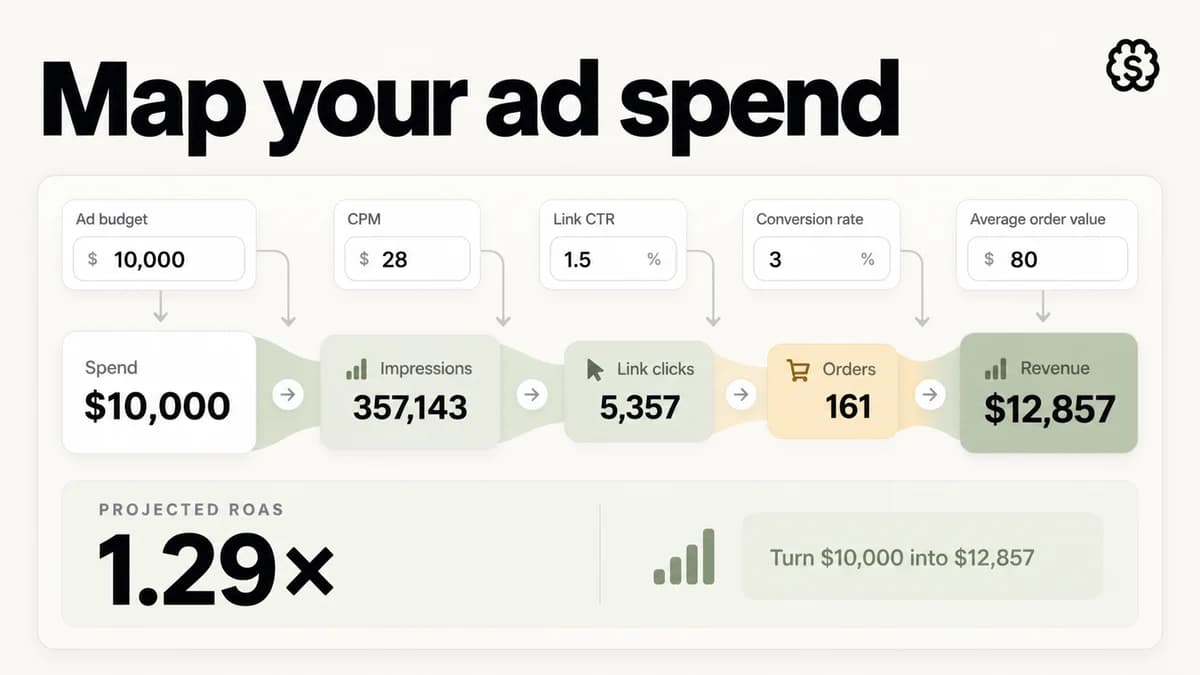
How the reverse chain works
Most media plans run forward: here is the budget, what does it buy? This calculator runs the same chain in reverse. Start from the revenue you need, divide down to orders, divide again to clicks, and price the clicks.
Clicks needed = Orders ÷ Conversion rate
Ad budget = Clicks needed × CPC
Implied ROAS = Revenue goal ÷ Ad budget
Two byproducts fall out for free. Implied CPA is CPC ÷ conversion rate: what each order will cost before you spend a dollar (the CPA Calculator works the same math from live spend). Implied ROAS is the return the whole plan quietly assumes. Both are worth staring at before you commit the budget, because the budget is only as honest as they are.
Worked example
The defaults model a brand that wants ads to drive $50,000 next month: $80 AOV, 3% click-to-order conversion rate, $1.87 CPC.
625 ÷ 3% = 20,833 clicks
20,833 × $1.87 = $38,958 ad budget
So the goal costs $38,958, nearly 78% of the revenue it produces. Implied CPA is $62.33 per order, and implied ROAS is 1.28. That last number is the tell: an $80-AOV brand with typical DTC margins breaks even around a 1.76 ROAS, so this plan hits its revenue goal and loses money on every order doing it. The chain is arithmetic; whether the answer is affordable is a margin question.
Sanity-check the implied ROAS before believing the plan
A budget that pencils is not a budget that profits. Run your real unit economics through the Break-Even ROAS Calculator and compare. If the implied ROAS here is above your break-even, the plan makes money at these assumptions and the budget is a real target. If it is below, as 1.28 is against a 1.76 break-even, no amount of spend fixes it, because every incremental order arrives at a loss.
Break-even ROAS is AOV ÷ contribution margin: what is left per order after product cost, shipping, and fees. A brand keeping $45.38 of an $80 order breaks even at $80 ÷ $45.38 = 1.76, the figure behind the worked example. Plan above break-even, not at it: refunds, discount codes, and mid-flight CPC drift all erode the margin the plan assumes. A 20% cushion, a 2.1 implied ROAS target against a 1.76 break-even, keeps one bad week from turning the quarter red.
This check takes two minutes and kills more bad quarters than any dashboard. Media buyers who skip it end up explaining why revenue hit plan and contribution missed it.
Where to get your CPC
Your own account, last 30 days, per campaign type. A real link CPC from your prospecting campaigns beats any benchmark, because CPC bakes in your audience, your creative, and your auction. Starting from zero, back into it from CPM and CTR:
A $28 CPM at a 1.5% link CTR is $28 ÷ 15 = $1.87 per click: the default here, and the same effective CPC the Ad Spend Calculator's forward projection produces. Use link CPC, not cost per click (all): reactions and profile taps never reach your site, and counting them understates the budget by 2–3×. Whatever number you use, treat benchmarks as directional and your own data as the answer.
In Ads Manager, customize columns to CPC (cost per link click) and filter to prospecting campaigns only. Retargeting clicks price lower because the audience already knows you, and blending them in flatters the cold-traffic budget this plan mostly buys. Match the lookback to the season you are planning: a CPC pulled from a quiet February reads low against a Q4 auction. If the spread across campaign types is wide, plan with the CPC of the type that will carry the incremental spend.
If the budget is unaffordable, fix the inputs, not the optimism
The wrong response to a scary budget is shaving the CPC assumption until the number fits. The auction does not negotiate. The inputs you actually control are conversion rate and AOV, and small moves in either compound through the whole chain.
From the defaults: lift conversion from 3% to 4% and the budget drops from $38,958 to $29,219. Implied CPA falls to $46.75 and implied ROAS rises to 1.71, nearly at break-even. Raise AOV from $80 to $100 with a bundle or post-purchase upsell and you need 500 orders instead of 625, a $31,167 budget at a 1.60 implied ROAS. Stack both and the plan turns profitable without touching the goal. That is landing page and offer work, and the conversion fix alone is worth $9,740 of media you no longer have to buy.
Frequently asked questions
How much should I spend on ads as a new brand?
Work backwards from a goal you can fund, not forwards from a round number. Set a modest first-quarter revenue goal, enter honest conversion and CPC assumptions, and see what the chain demands. If the budget exceeds what you can lose while learning, shrink the goal. Early spend is tuition for real CTR, CVR, and CPC data, and 50–100 orders is enough to replace assumptions with facts.
Should I budget daily or monthly?
Plan monthly, operate daily. The chain works on any period, but auctions and conversion rates swing too much day to day to judge. Divide the monthly figure by ~30 for pacing: the example's $38,958 is about $1,299 a day. Then hold daily budgets steady for a week at a time so the platform and your read both stabilize.
What if the implied ROAS is below my break-even?
Do not launch the plan as-is. Below break-even, hitting the revenue goal loses money on every order, and scaling makes it worse. Improve conversion rate or AOV until implied ROAS clears break-even with room to spare, or lower the goal to what profitable spend can support. The one exception is a deliberate, capped first-order loss against known repeat purchase behavior: a written policy, not a hope.
Should the budget include creative costs?
Not in this calculator: CPC only prices media. But budget creative separately and deliberately, because fresh creative is what keeps the CPC you entered from drifting up as ads fatigue. Many DTC teams hold a single-digit percentage of media spend for creative production and testing; treat that as a planning starting point, not a rule.
What conversion rate should I use?
Cold-traffic conversion rate, orders ÷ link clicks, from your own last 30 days. Blended site conversion flatters the math because it includes email, brand search, and returning visitors. If you have no history, 2–4% is a directional range for a healthy DTC product page at typical AOVs. Plan at the middle, not the edge.
How fast can I scale a working budget?
Gradually, and re-run this math at each step. Scaling raises CPMs and reaches colder audiences, so CPC and conversion rate both degrade at the margin. The chain that penciled at $39,000 may not pencil at $80,000 with the same inputs. A common discipline is raising budgets 20–30% at a time, letting a week of data settle, then updating CPC and CVR here before the next step.
Where StefanBrain fits
This calculator tells you what the goal costs at today's conversion rate and CPC. Improving those two numbers is what StefanBrain is built for: it generates static ads, video ads, landing pages, and copy tests, launches them to Meta, and learns from results. Then run the Ad Spend Calculator forward to check what the budget you just computed should deliver. The two tools are the same chain read from opposite ends.