What is CPM?
CPM is cost per mille: what you pay for 1,000 impressions. It is the price of attention before anyone clicks, and the first number in every paid social projection. One identity covers all three questions media buyers actually ask: what did delivery cost, what will this flight cost, and what does this budget buy.
Spend = CPM × Impressions ÷ 1,000
Impressions = Spend ÷ CPM × 1,000
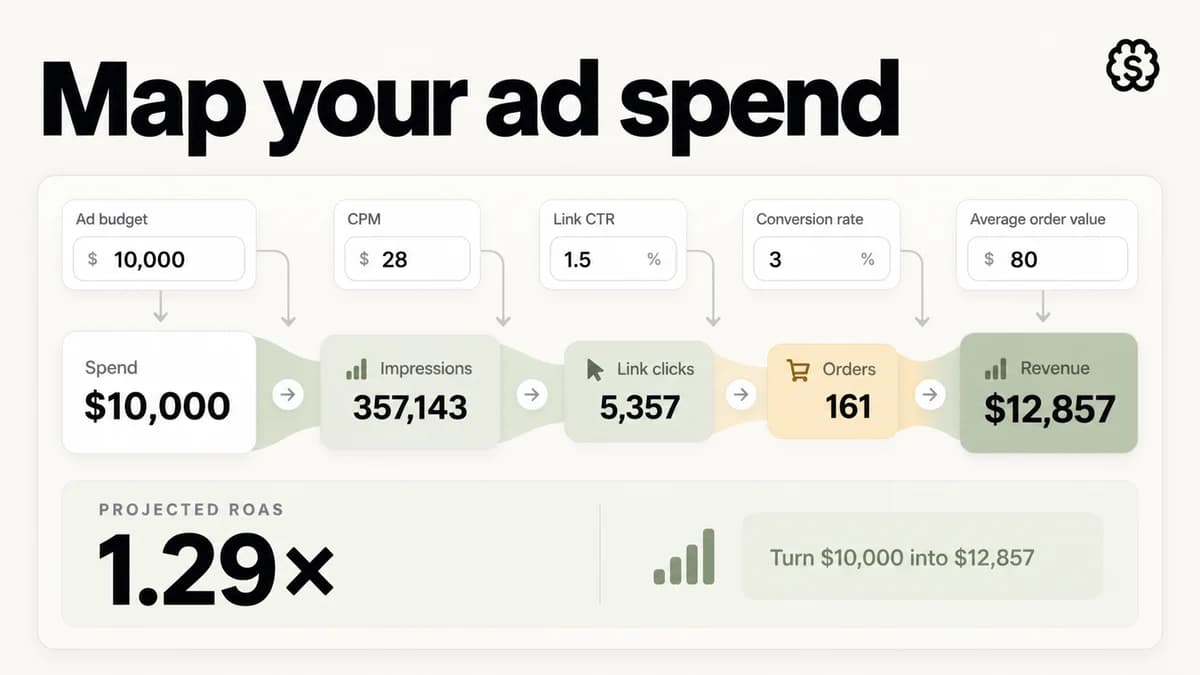
Auditing last month's delivery? Solve for CPM. Pricing a reach goal? Solve for spend. Sizing what a test budget buys? Solve for impressions, then sanity-check the full funnel in the Ad Spend Calculator.
Worked example
The default CPM mode models a mid-size Meta campaign: $4,200 of spend delivered 150,000 impressions. That is $4,200 ÷ 150,000 × 1,000: a $28.00 CPM, or 2.8¢ every time the ad is served.
The other two modes run the same identity backwards. At a $28 CPM, a 500,000-impression flight costs $28 × 500,000 ÷ 1,000 = $14,000. And a $4,200 budget at a $28 CPM buys $4,200 ÷ $28 × 1,000 = 150,000 impressions. Same equation, three doors in.
What moves your CPM
Audience size. CPM is an auction price, and narrow audiences mean fewer people to bid on. A 400,000-person interest stack costs more per thousand than broad targeting, and burns through its frequency ceiling faster too.
Placement. Feed and Reels price differently, and forcing manual placements removes Meta's cheapest inventory from the mix. Advantage+ placements usually deliver a lower blended CPM than any hand-picked subset.
Competition. You are bidding against every advertiser who wants the same eyeballs, not just your category. When a well-funded competitor scales into your audience, your CPM moves and nothing in your account explains why.
Seasonality. Q4 is the big one: retail budgets flood the auction from late October through Black Friday, and CPMs climb well above the annual baseline. Plan holiday flights at holiday prices, not September prices.
What is a normal CPM in 2026?
For US DTC brands on Meta, $20–45 is a reasonable directional range for prospecting in 2026. Treat it as a planning envelope, not a target. Broad audiences and strong creative sit near the bottom. Narrow audiences, retargeting pools, and Q4 sit near the top, sometimes well past it.
Two cautions before comparing your number to anyone else's. Category matters: finance and supplements pay more per thousand than apparel. And optimization goal matters most of all: a purchase-optimized campaign buys expensive, high-intent impressions, while a reach campaign buys cheap ones. A “good CPM” on one objective is a broken campaign on another.
Cheap CPMs are not the goal
CPM is a cost input, not a performance metric. The auction prices impressions by the value other advertisers see in them, so the cheapest thousands are usually cheap because nobody else wants those eyeballs. Chase CPM down and you drift toward low-intent inventory and audiences that never buy.
The math makes it concrete. An $18 CPM with a 0.8% CTR yields 8 clicks per thousand, or $2.25 per click. A $28 CPM with a 1.4% CTR yields 14 clicks per thousand, or $2.00 per click. The “expensive” delivery produces cheaper clicks, and typically better ones. Run your own numbers through the CPC Calculator and the CTR Calculator before celebrating a cheap CPM.
Frequently asked questions
What is a good CPM on Meta?
For US DTC prospecting in 2026, $20–45 is the directional range; where you land depends on category, audience size, and optimization goal. But judge campaigns on cost per order and ROAS, not CPM. A $40 CPM that converts beats a $15 CPM that does not, every time.
Why did my CPM spike?
The usual suspects, in order: seasonality (Q4 above all), a new competitor scaling into your audience, creative fatigue dragging down engagement and your auction ranking, or edits that reset learning. Frequency creeping past ~3 on a small audience produces the same effect: you are rebuying the same people at rising prices.
What is the difference between CPM and CPC buying?
With CPM buying you pay per 1,000 impressions and your creative's CTR determines what each click costs. With CPC buying you pay per click directly. Meta charges by impressions for most objectives, so the conversion is CPM ÷ clicks per thousand: a $28 CPM at a 1.4% CTR is $2.00 per click.
Does a lower CPM mean better performance?
No. CPM measures the price of attention, not its quality. The auction discounts impressions that other advertisers do not value, so unusually cheap delivery often means low-intent placements or audiences unlikely to convert. Judge the funnel end to end, from CPM through CTR to conversion rate, and let cost per order be the verdict.
How does audience size affect CPM?
Smaller audiences give the auction fewer people to choose from, so you pay more per thousand and hit high frequency sooner, which raises CPM further. Broad audiences are cheaper because Meta can hunt for the easiest conversions across a larger pool. The trade: broad targeting leans entirely on creative to find your buyer.
Is CPM the same as eCPM?
Functionally, yes. eCPM (“effective CPM”) is spend ÷ impressions × 1,000 computed after the fact, whatever pricing model you bought on. That is exactly what this calculator's CPM mode computes, which makes it the honest way to compare delivery cost across channels and objectives.
Where StefanBrain fits
You rent your CPM from the auction; creative is the lever you actually own. Strong ads earn better auction rankings, cheaper delivery, and more clicks from every thousand impressions. StefanBrain generates and iterates that creative, from static ads and video ads to landing pages, launches it to Meta, and learns from results. Then use the Ad Spend Calculator to see what your CPM implies for orders and ROAS.