CTR Calculator

Enter clicks and impressions to get your link click-through rate, or flip the toggle to project the clicks a planned impression volume should deliver.

Link CTR

1.50%

Compare against your own 30-day history.

Try:
Solve for

The Link clicks column in Ads Manager: clicks that left the platform for your site.

The Impressions column from the same Ads Manager row: times the ad was served, not unique people.

  1. Impressions

    357,143

    Ads served

  2. Link clicks

    5,357

    1.50% click through

Clicks per 10k impressions

150

Same rate, easier to gut-check.

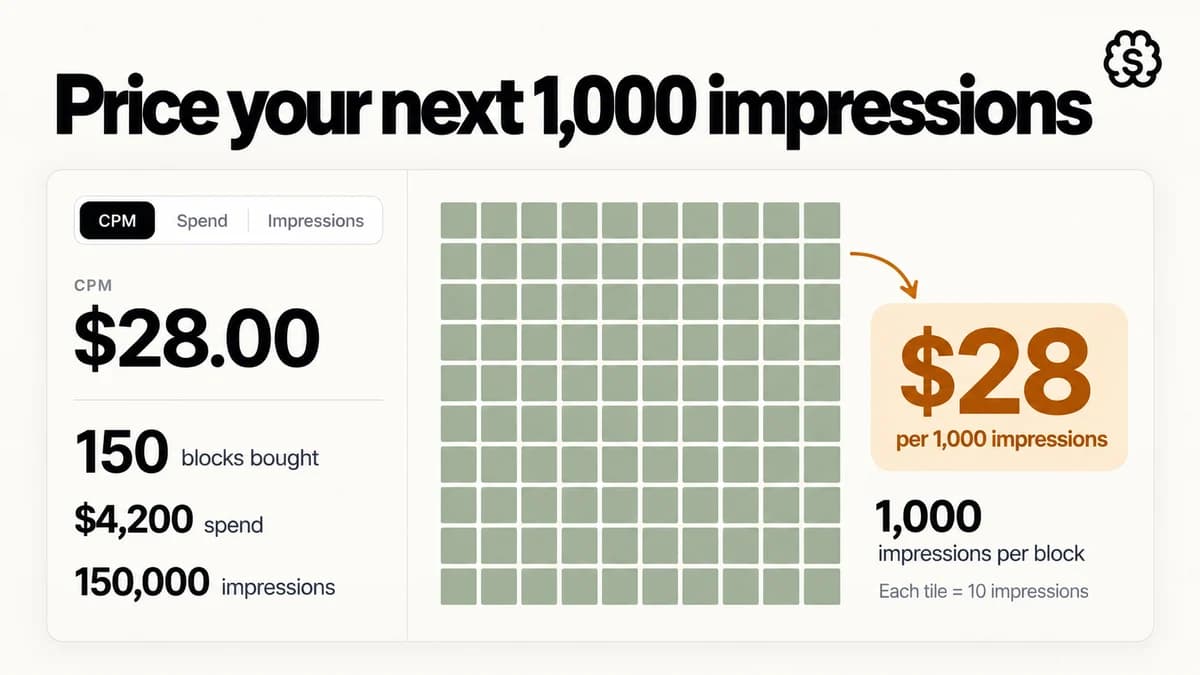
Implied CPC at $28 CPM

$1.87

What each click costs at that CPM.

CPC = CPM ÷ (10 × CTR%), so lift CTR and your CPC falls in direct proportion.

What is CTR?

Click-through rate is the share of impressions that turn into clicks. It is the first ratio in every paid social chain: before anyone can convert, they have to click.

CTR (%) = Clicks ÷ Impressions × 100
Expected clicks = Impressions × CTR (%) ÷ 100

For anything involving money, use link clicks: the clicks that actually leave Meta for your site. A 1.5% link CTR means 150 clicks per 10,000 impressions, which is the version of the number your gut can check. The calculator shows both, plus the CPC your CTR implies at a reference $28 CPM.

Worked example

The defaults describe a typical Meta prospecting month: 5,357 link clicks on 357,143 impressions.

5,357 ÷ 357,143 × 100 = 1.50% link CTR

That is 150 clicks per 10,000 impressions. At a $28 CPM it implies a $1.87 CPC. Those impressions cost about $10,000, which is why these numbers match the Ad Spend Calculator's default month. The two tools are the same chain read from different ends.

Flip the toggle to Clicks mode to plan forward. 500,000 impressions at a 1.5% CTR should deliver 7,500 clicks. Hold delivery constant and push CTR to 2%, and the same impressions deliver 10,000, a gain of 2,500 clicks without spending another dollar. That is the whole argument for creative work in one subtraction.

Link CTR vs. CTR (all)

Meta reports two CTRs, and they are not close. CTR (all) counts every interaction with the ad: reactions, comment expands, profile taps, “see more” clicks. Link CTR counts only outbound clicks that land on a page that can convert. CTR (all) commonly runs 2–3× link CTR on the same ad.

Always plan with link CTR. It is the number that connects to CPC, conversion rate, and CPA: the money math. When someone quotes a CTR benchmark, confirm which version it is first; most inflated screenshots are CTR (all). Every formula on this page assumes link clicks.

What counts as a good link CTR on Meta?

Directionally, not as gospel: DTC prospecting on Meta tends to land between 0.9% and 1.8% link CTR, and strong creative clears 2%. Offer, price point, and audience temperature all move the number: retargeting runs well above these ranges because the audience already knows you. Judge campaigns against their own history before any benchmark.

CTR compounds through cost. At the same $28 CPM, a 0.9% CTR is a $3.11 CPC, 1.8% is $1.56, and 2% is $1.40. Same auction, same budget, yet the click price more than halves between the bottom and top of that range. Run your own delivery numbers through the CPC Calculator to see what your CTR is costing or saving you.

Measure CTR in segments, not blends

An account-level CTR averages things that should never be averaged. Retargeting clicks at multiples of prospecting. Reels, Feed, and Audience Network each click differently. Last month's fatigued creative drags on this week's launch. The blend can look fine while the part that matters is broken: 80% of impressions on prospecting at 0.8% plus 20% on retargeting at 3.8% blends to a respectable-looking 1.4%.

So cut the number three ways before reacting: prospecting vs. retargeting, placement, and creative launch date. Run each segment through the calculator against its own history over a fixed 7- or 14-day window. Then react to the segment that moved, not the blend.

CTR is a creative quality signal

The auction sets your CPM; your creative sets your CTR. The hook, the angle, and the first visual decide whether anyone stops scrolling; targeting and bids only decide who gets the chance to. When CTR moves in an account, a creative change moved it.

The worked example makes the stakes concrete: lifting CTR from 1.5% to 2% is 33% more clicks from identical spend. No bid strategy produces that. For video ads there is also an upstream gate: viewers who scroll past the first 3 seconds never see the offer at all. Measure that gate with the Hook Rate Calculator; a weak hook caps CTR before the click is even possible.

Frequently asked questions

What is a good CTR for Meta ads?

Directionally, DTC prospecting link CTR lands between 0.9% and 1.8%, and strong creative clears 2%. Retargeting runs higher because the audience already knows the brand. Judge a campaign against its own history and its CPA: a 1.2% CTR that converts beats a 2.5% CTR that does not.

Should I use link CTR or CTR (all)?

Link CTR, for anything that touches money. CTR (all) counts reactions, comment expands, and profile taps that never reach your site, and commonly runs 2–3× link CTR on the same ad. It is a rough engagement gauge at best. This calculator's math assumes link clicks.

My CTR is high but I get no sales. What is wrong?

The click and the sale are separate promises. Usual causes: a curiosity hook attracting clicks the offer can't convert, a slow or weak landing page, or the wrong audience clicking. Check the next ratio in the chain with the Conversion Rate Calculator. If clicks are cheap but orders are not, the problem lives after the click.

Does CTR affect CPM?

Indirectly. Meta's auction ranks ads partly on expected engagement, so ads people click tend to earn cheaper delivery. But don't chase CTR to discount CPM; you can't bank a CPM discount. The reliable effect is arithmetic: at any CPM, higher CTR means a proportionally lower CPC.

How do I improve CTR?

In rough order of leverage: new hooks (first line, first frame), new angles (the reason to care), new formats, then new audiences. Change one variable at a time and give each variant enough delivery to read. The first 3 seconds of a video or the visual of a static move CTR more than any primary-text edit.

What CTR should I assume when planning without history?

Plan cold DTC traffic at 1.2–1.5% link CTR and treat anything above as upside. If a media plan only pencils above 2%, you are betting on exceptional creative, so budget the testing to earn it. Once real delivery exists, replace the assumption with your own 30-day segment numbers.

Why does my CTR drop when an ad runs longer?

Fatigue. The people most likely to click were reached first; as frequency climbs, the remaining audience has already seen the ad and scrolled on. Watch frequency alongside CTR: when CTR sags while frequency climbs, refresh the creative instead of raising bids.

Where StefanBrain fits

Every number on this page points at the same conclusion: CTR is a creative problem wearing a math costume. StefanBrain generates the hooks, angles, static ads, and video ads that move it, launches winners to Meta, and reads the results back. Once the clicks land, make them count: the Conversion Rate Calculator shows what your traffic is worth after the click.

More free tools

CTR is a creative problem. Solve it at scale.

StefanBrain generates the hooks, angles, static ads, and video ads that move CTR, trained on 7+ years of DTC marketing IP, then launches winners straight to Meta.

Built for brands serious about growth.