What is hook rate?
Hook rate is the share of impressions that become 3-second video plays. It answers one question: does the opening of your video stop the scroll? On Meta, a 3-second video play counts once your video has played for at least 3 seconds, sound on or off.
Hold rate = ThruPlays ÷ 3-second video plays × 100
Hold rate reads the next stage of the same funnel. A ThruPlay is a play to 15 seconds, or to the end for shorter videos. So hold rate asks: of the viewers the hook caught, how many kept watching? A strong hook with a weak hold means the first frame promises something the next 12 seconds don't deliver.
Worked example
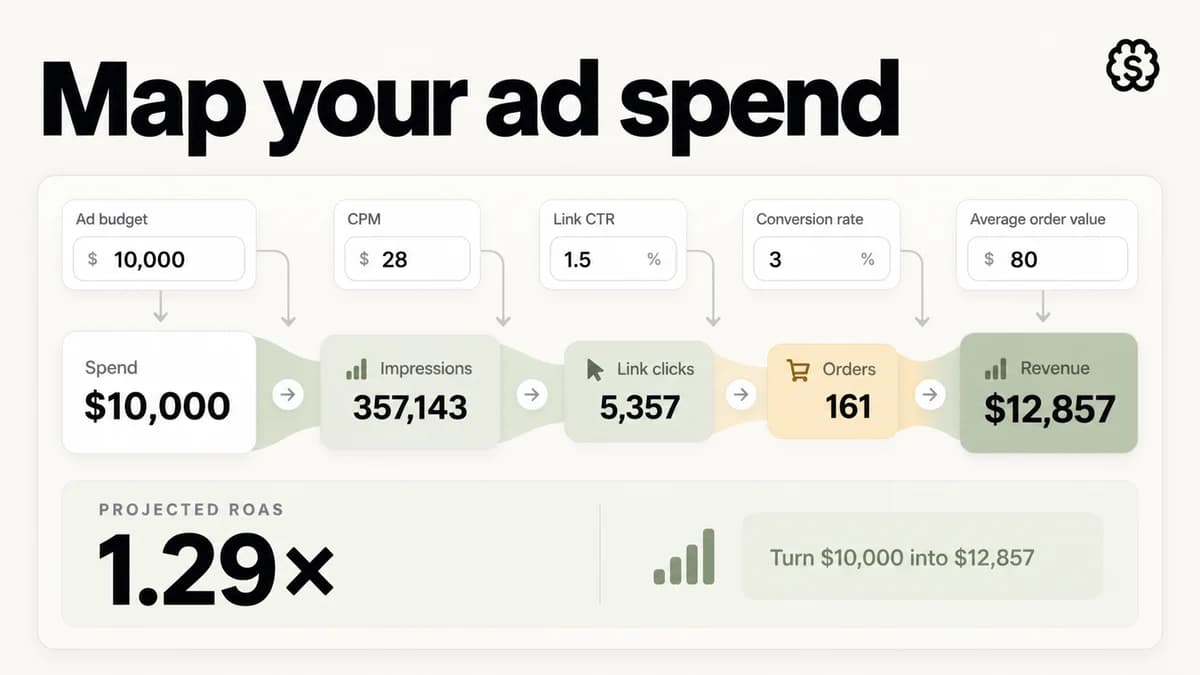
Take the calculator's defaults: 357,143 impressions, 85,000 3-second video plays, and 15,000 ThruPlays, roughly what a $10,000 month at a $28 CPM serves.
15,000 ÷ 85,000 × 100 = 17.65% hold rate
That is 238 three-second plays per 1,000 impressions: roughly 1 in 4 people who were served the ad stopped for the opening. Of the 85,000 who stopped, 15,000 reached a ThruPlay: a 17.65% hold rate, about 1 in 6. End to end, 4.2% of all impressions watched past 15 seconds. Each stage tells you where viewers leave, which is exactly what a single view-through number hides.
What is a good hook rate?
Directional, not gospel: 20–30% is a solid hook rate for Meta feed and Reels placements. The example's 23.80% sits in that band. Under 20%, your first 3 seconds are the bottleneck. Fix them before touching anything downstream. Over 30%, the hook is doing its job; your leverage moves to hold rate and CTR.
Placement mix bends the number, so audit it before reacting. Sound-off feed scrolling, auto-advancing Stories, and Reels all produce different baseline behavior from the same creative. The cleanest read is always relative: the same account, the same placement mix, this hook against your last five. A creative that beats your account median by 5 points matters more than one that beats a stranger's benchmark.
Hook rate vs. CTR: two different diagnoses
Hook rate diagnoses the first 3 seconds. CTR diagnoses the offer and the curiosity to click. They fail independently, which is why you read them together. High hook, low CTR: the opening stops people, but the body or offer doesn't convert attention into a click. Low hook, high CTR: the few viewers who stop are highly qualified, but the opening wastes most of the reach you paid for.
Run your click numbers through the CTR Calculator alongside this one and the pair points at the broken stage. One more pattern worth watching: a proven creative whose hook rate decays week over week is usually fatiguing, not broken. Check it against the Ad Frequency Calculator before you rewrite anything.
How to raise your hook rate
Pattern interrupts: open on motion, an unexpected image, or mid-action, never a logo or a slow establishing shot. The viewer decides in the first swipe-length whether you are content or an ad.
First-frame text: most feed viewing is sound-off, so put the claim or the curiosity gap on screen in frame one. If the video needs audio to make sense by second 3, the hook loses the muted majority.
Native formats: UGC-style openings, replies, and green-screen commentary. Formats that look like the surrounding feed get the extra beat of attention a polished ad never receives.
Then test hooks as their own variable: keep the body of the video fixed and swap 3–5 different opening seconds. Hook variations are the cheapest creative test in paid social because you reuse everything after second 3.
Frequently asked questions
What counts as a 3-second video play?
Meta counts a 3-second video play when your video plays for at least 3 seconds, including sound-off autoplay in feed. It is a play-time metric, not an attention guarantee, but at feed scroll speeds, 3 seconds of dwell is a meaningful signal.
What is a good hook rate?
As a directional band, 20–30% is solid for Meta feed and Reels placements. Placement mix, audience temperature, and format all move the baseline. The more useful comparison is internal: rank your own ads by hook rate over the same period and placements, then study what the top three openings have in common.
Hook rate vs. CTR: which matters more?
Neither alone. Hook rate is upstream: it gates how many people ever see your message. CTR is closer to money: it measures whether the message earned a click. Fix the hook first when it is below the band, because nothing downstream can recover viewers who scrolled at second 1. Then judge winners by CTR and cost per acquisition.
What is a ThruPlay?
A ThruPlay is Meta's count of plays to 15 seconds, or to completion for videos shorter than 15 seconds. This calculator uses it as the hold-rate numerator: of the people your hook caught, how many stayed through the pitch window. Meta also sells ThruPlay as an optimization and billing option, which is a separate decision from measuring it.
My hook rate is high but conversions are low. What's wrong?
The hook is writing a check the rest of the funnel can't cash. Pure curiosity openings stop everyone, including people who will never buy, so the click and the purchase never come. Check hold rate and CTR to locate the drop: a collapse right after second 3 means the hook and the body are mismatched. Align the opening's promise with the actual offer, even if hook rate dips a few points.
Why is my hook rate over 100%?
Impressions and video plays come from different reporting pipelines, and on small samples or mixed placements their windows can disagree. Treat a hook rate near or above 100% as a data-quality flag: re-pull a longer date range and check per-placement breakdowns before celebrating.
Where StefanBrain fits
This calculator tells you whether the first 3 seconds work. Producing 5 new openings a week is the actual job, and that is what StefanBrain does. It generates video ad hooks, scripts, and cutdown variations, launches them to Meta, and reads the hook and hold numbers back. Before you spin up that test, size it with the Creative Testing Budget Calculator so every hook variant gets enough impressions for a readable hook rate.