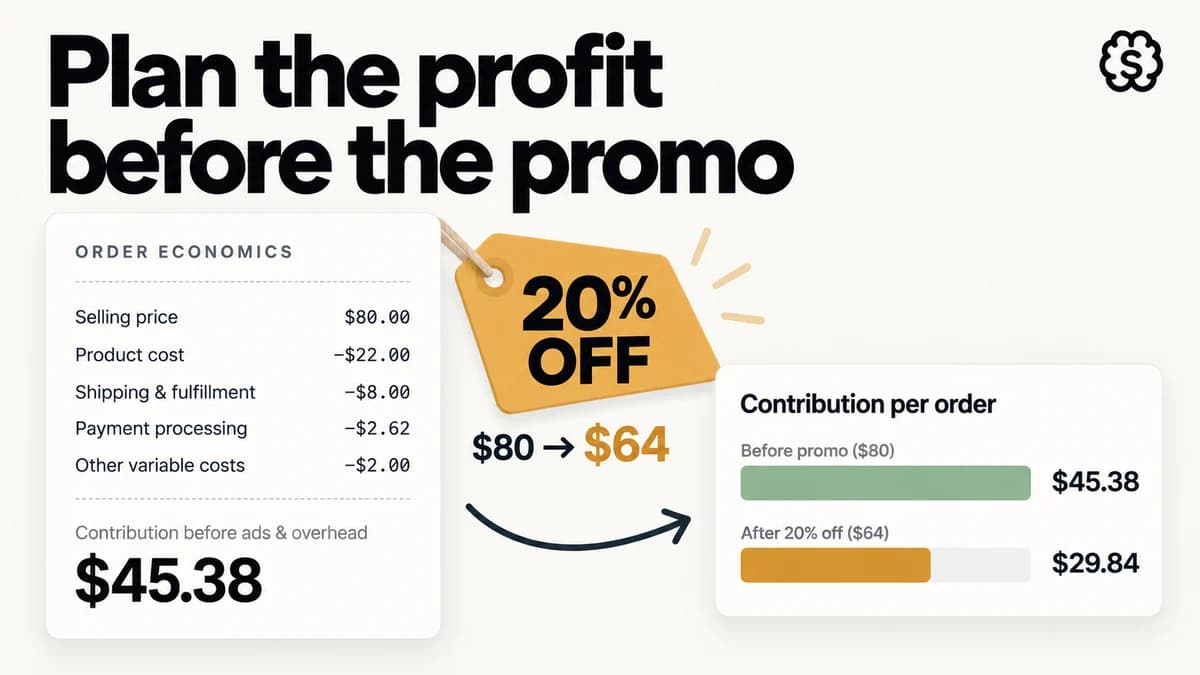
Establish the regular-price contribution first
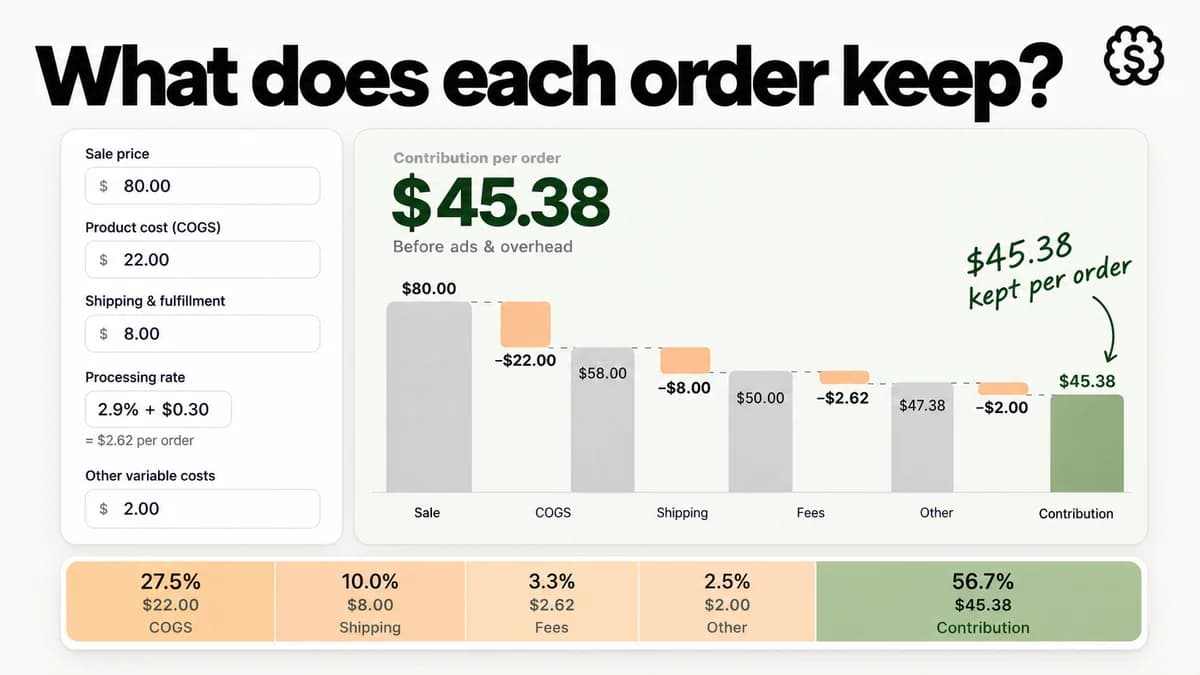
A promotion needs a baseline. Record what a typical order contributes at its regular selling price after the variable costs you intend to include. Product cost alone may omit fulfillment, payment fees, shipping subsidy, and expected returns. Use a consistent cost definition throughout the campaign plan.
The Contribution Margin Calculator helps organize revenue and variable costs before advertising. Keep acquisition and other marketing costs separate when comparing contribution before and after the campaign. If the same expense appears in both buckets, the plan will count it twice.
Use a hypothetical product priced at $100 with $40 of variable cost per order. It contributes $60 before advertising and fixed costs. At 100 orders, total contribution is $6,000. These are illustrative inputs, not a claim about any StefanBrain customer or a recommended margin for a category.
Price the contribution you give up
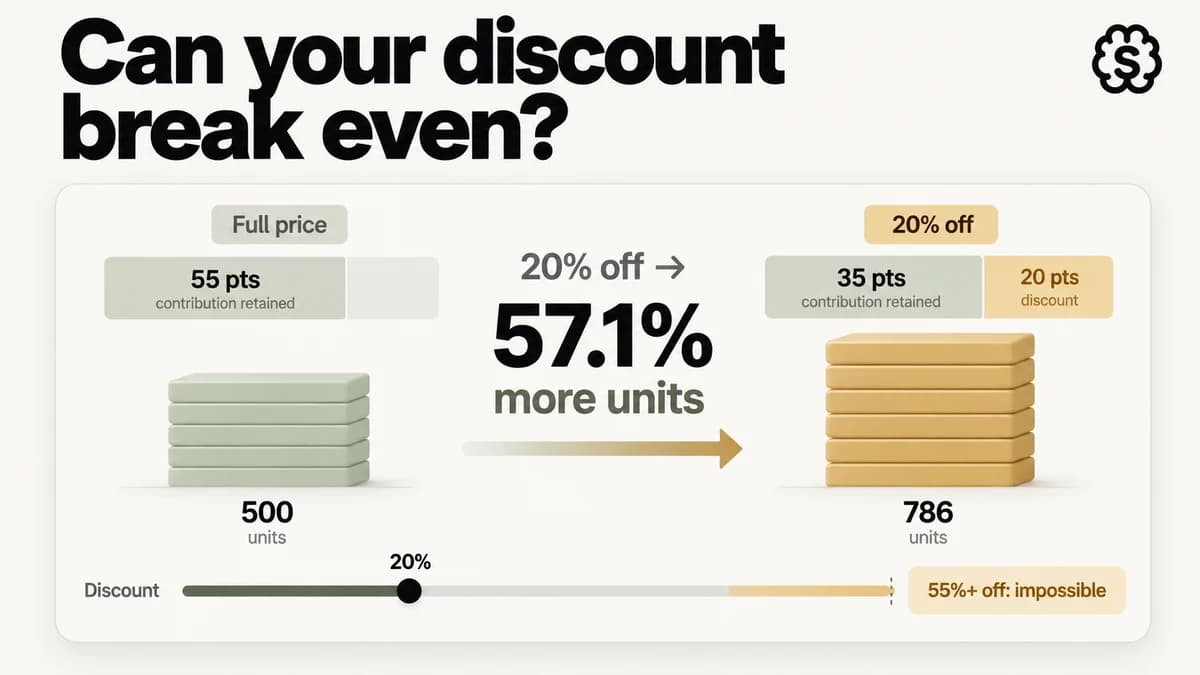
A 20% discount reduces the selling price to $80. Holding variable cost at $40, each discounted order contributes $40. The customer saves $20, while contribution per order falls by one third. The discount percentage and the percentage loss of contribution answer different questions.
The simplified example holds variable cost constant to make the trade visible. In a real campaign, payment fees may change with price, shipping mix may shift, and additional volume may affect fulfillment costs. Replace the assumption with the expected cost structure before committing to an offer.
That is a 50% increase in orders just to maintain contribution before additional marketing and fixed costs. Revenue rises from $10,000 to $12,000 in this comparison. The higher revenue does not mean the promotion created more contribution. It only restores what the original 100 orders already produced.
Use the discount calculator on the right basis
The Discount Break-Even Calculator takes the original margin percentage and discount percentage. For this example, enter 60% margin and a 20% discount. The remaining contribution is 40 percentage points of the original price, which corresponds to $40 on the $100 product.
Do not confuse that result with the margin rate on promotional revenue. At an $80 selling price, the same $40 contribution is a 50% margin. That is the rate relevant when multiplying promotional revenue by margin or calculating a contribution-based break-even ROAS for the discounted order.
If the discount consumes the full original contribution under the model, more orders cannot restore the lost contribution. Each additional order contributes nothing or loses money before acquisition. A separate strategic purpose may exist, but the campaign should not be described as profitable order growth on these assumptions.
Add the campaign costs the first calculation omitted
Suppose the promotion also requires $1,000 of incremental marketing cost beyond the baseline plan. The discounted orders must now contribute $7,000 to preserve the original $6,000 after that extra expense. At $40 contribution per order, the requirement rises to 175 orders.
Include relevant incremental media, creative, agency, and campaign production costs once. Distinguish new costs from expenses already included in the baseline. A before-and-after comparison becomes misleading if the baseline excludes ordinary marketing while the promotion includes every department's monthly budget.
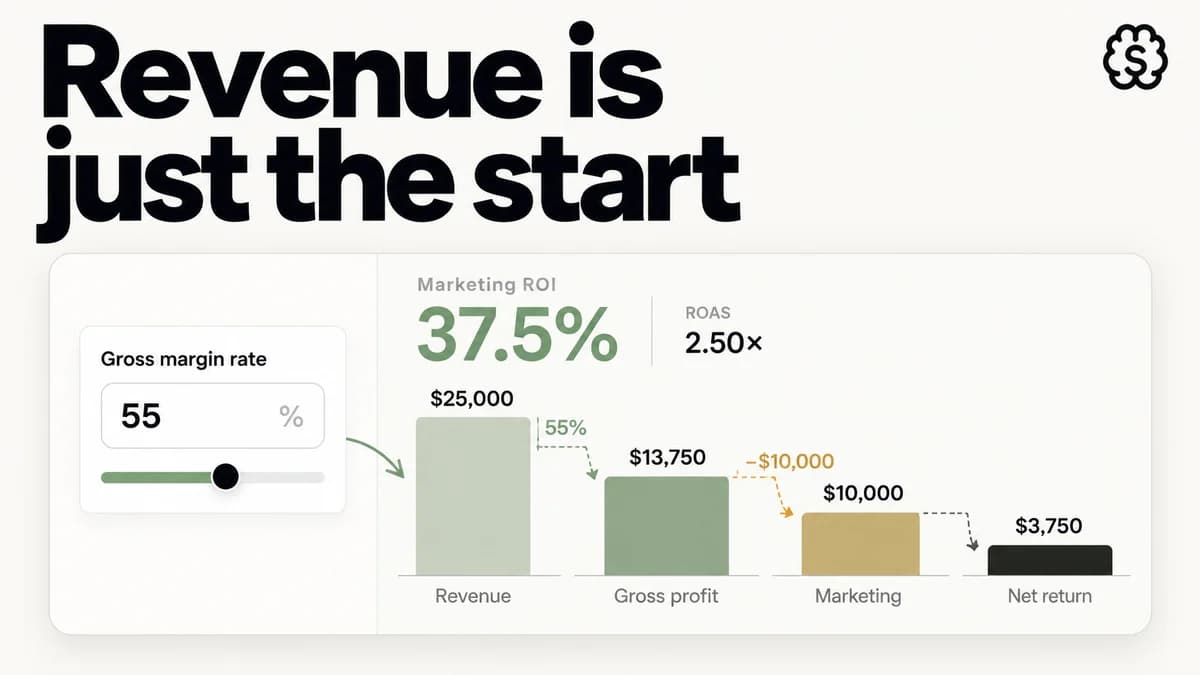
The Marketing ROI Calculator relates revenue, a selected margin rate, and marketing cost. Its output covers the costs supplied to it. If your margin excludes variable fulfillment or returns, the resulting return is not fully loaded profit. State the cost basis and reconcile omitted expenses separately.
Recalculate the acquisition hurdle for the offer
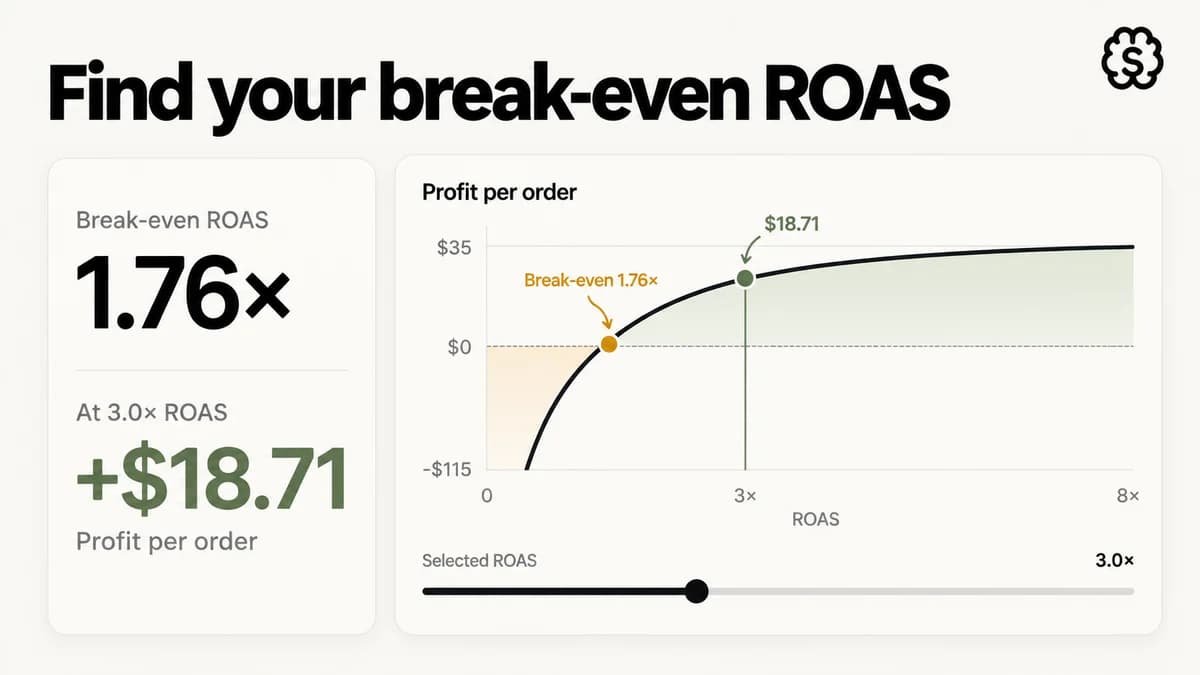
The Break-Even ROAS Calculator connects the order margin to the revenue required per advertising dollar. With 60% contribution margin, the simplified break-even ROAS is about 1.67. With the promotion's 50% contribution margin, it becomes 2.00, before any additional profit requirement.
Use those thresholds with the correct revenue and attribution definitions. Attributed ROAS can be useful operationally without proving incremental revenue. A reported ratio above the modeled hurdle does not settle whether the promotion created new demand or gave a discount to customers who would have bought at full price.
Do not apply the regular-price hurdle unchanged to a discount campaign. The offer can improve conversion while reducing contribution per order. Both effects matter. Connect the proposed order lift, acquisition cost, and margin assumptions in one scenario instead of selecting whichever metric makes the offer look strongest.
Ask where the extra orders would come from
Some promotional orders may be new demand. Others may be purchases pulled forward from next week or purchases that would have happened at regular price. Discounting existing demand reduces contribution without adding the corresponding volume. A launch-day revenue chart cannot identify these groups by itself.
Plan an appropriate comparison where practical, such as an eligible randomized holdout with consistent measurement. Otherwise use the best available baseline and state its limitations. Account for seasonality, other campaigns, stock changes, and conversion timing. A forecast with these uncertainties visible is more useful than a precise but unsupported lift estimate.
Check operational capacity as part of the plan. Additional orders can require inventory cash, packing capacity, and support work before receipts settle. Model likely returns and cancellations consistently. A campaign that meets its initial contribution target can look different after the full order cohort matures.
Approve an offer with explicit conditions
Write the approved price, eligible products, campaign dates, terms, contribution basis, incremental cost budget, and required order scenario together. Name who will review results and when. These details give the copywriter, media buyer, and finance owner the same campaign to work from.
Review the ad and destination for the same offer. The CRO workflow can help identify unclear pricing and page friction, while the message match guide covers consistency after the click. Better communication supports a fair test; it does not change the underlying contribution arithmetic.
After the campaign, compare realized order volume, net revenue, variable costs, and incremental marketing with the original assumptions. Revisit the result after returns and delayed purchases are visible. Keep the decision grounded in contribution and the quality of the comparison, rather than treating a larger revenue total as the final answer.